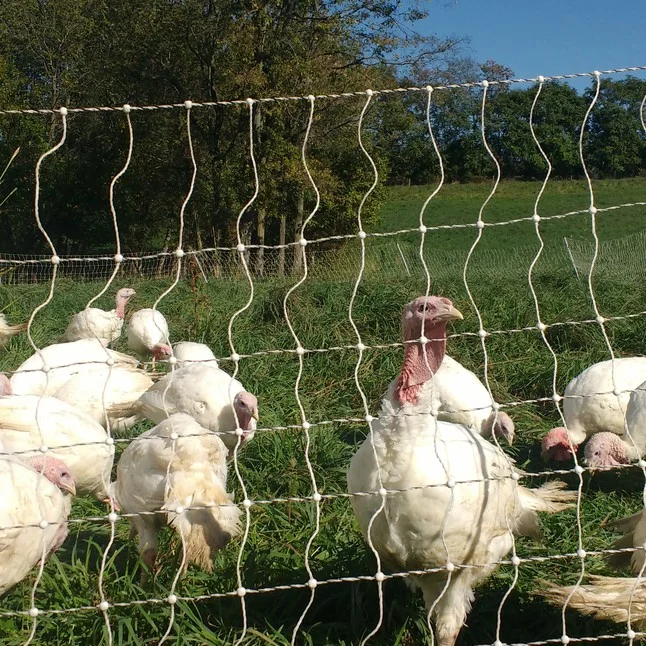
After two weeks in the brooder, our Thanksgiving turkeys spend the rest of their lives outside, on fresh pasture. Turkeys are eager foragers, and they love nothing better than stalking bugs in the grass. Our turkeys cost $4/lb and weigh between 11 and 20 lbs. We offer delivery to North Chevy Chase for an additional 30 cents per pound. In order to reserve your turkey, please fill out our online order form.
For information about our Thanksgiving turkeys, please contact us at openbookfarm@gmail.com or 240.457.2558. Please read our FAQs below, and also check out Our Growing Practices for more information about how we keep our turkeys – and our other animals – happy, healthy, and drug-free.
- this little guy showed up unbidden along with our white turkeys. He is a broad breasted bronze, which means that he’ll grow at the same speed as the others, just with different plumage.
- turkeys need to eat grit (literally little rocks!) so that their gizzards can digest the more fibrous parts of their diet.
- Patou guarding his charges
Turkey FAQs
1) Can I buy a fresh turkey, rather than a frozen one?
Unfortunately, no. We process all of our poultry by the end of October for several reasons: a) colder temperatures, shorter days, and slower grass growth makes pasturing animals in November harder on the animals and on the pasture; b) raising the birds to a proper slaughter weight, neither too big nor too small, is quite complicated if we have only one or two possible slaughter days immediately before Thanksgiving; and c) it would be very difficult for us to keep the turkeys at a consistent refrigerator temperature.
2) Do you raise any heritage breed turkeys?
At this point, we do not. Heritage breed turkeys grow at approximately half the speed of the broad breasted white, and therefore require approximately twice the feed and twice the labor to raise. We must pass those additional costs on to the customer. If you are interested in purchasing a heritage turkey at a price around $7.50/lb, please let us know. With sufficient customer demand, we would certainly consider it.
3) When you say “pastured” what does that mean?
When our turkeys are very young and vulnerable poults, we raise them in our barn alongside our baby chicks in the warmth of a “brooder.” After two or three weeks, we move the birds outside into our portable, floorless shelters, which we move once or twice daily onto fresh grass. By the time the chickens have reached a slaughter weight, the turkeys are big and savvy enough that they no longer need as much protection. We then cordon off a section of pasture with electrified poultry netting and transfer the turkeys into it. We move them onto fresh pasture every 2-3 days.
4) Do you feed your turkeys organic grain?
We do not feed any of our animals organic grain. We buy our feed from a local non-organic mill. We would be happy to give only organic feed to a group of our animals if there is sufficient customer demand. The prices would be about 50% more than what we charge now. Please let us know if we should record your interest.
5) I’ve heard that turkeys are fantastically stupid; how do you keep your turkeys from dying ?
Though they have a reputation for stupidity, turkeys are in fact quite intelligent. Turkeys are extremely social animals and learn by watching other birds. For example, many farmers will tell you that turkey poults have a high mortality rate. We solve this by raising our turkey poults alongside our broiler chicks. (We got this idea from Sheri Salatin, now of Polyface Farms). The broilers “teach” the turkeys where to find the water and the feed. As the turkeys grow up, they learn more and more, and they quickly surpass their chicken teachers.
That said, any domesticated poultry animal has a certain amount of inherent vulnerability, which we attempt to mitigate by keeping a livestock guard dog. Our Great Pyrenees, Patou, was raised on a farm and treats all of our livestock as his charges. While he is extremely friendly toward humans, he considers all wild animals (except turkeys, funnily enough) as threats to his territory. Patou does a great job of keeping our fields free of coyotes, foxes, local dogs, and even groundhogs and deer.


Pingback: No Turkeys from Smith Meadows this year | Smith Meadows